Skip to content

Automated External Defibrillators (AED) locations

Locate automated external defibrillators (AEDs), learn emergency response steps, and access AED/CPR training and resources.

Topics on this page:

AED locations

Everyone can be a good bystander and help save a life during a cardiac emergency.

Automated external defibrillators (AEDs) are maintained by the Office of Environmental Health and Safety and are available across the University’s campuses.

Use the map on the right to locate AEDs near classrooms, residence halls, study areas, and other campus facilities.

STAY CALM AND ACT

During a cardiac emergency

  1. Call 911, or University Public Safety at (585) 275-3333 or by picking up a Blue Light Emergency Phone.
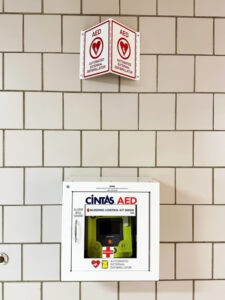
  2. An AED cabinet is located within an anticipated 2-minute response time from most locations on campus, and they are placed in high-traffic areas for easy identification. Head quickly to the nearest likely location (e.g., near entryways, elevators, and restrooms in residence halls, schools, and public spaces) and look for the red and white AED cabinet.
  3. Follow the instructions in the kit while waiting for help to arrive.
PREPARE

Before a cardiac emergency

  1. Familiarize yourself with AED locations on campus. View the map above to find AEDs in areas you visit most often (e.g., classrooms, residence halls, study areas, and eateries). Keep an eye out for the red and white cabinet markers and make a mental note for future reference.
  2. Sign up for an American Heart Association “HeartSaver” CPR AED  training or other life-saving interventions.
  3. Contact the Office of Environmental Health & Safety with any questions about the equipment in your area.

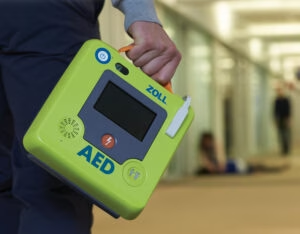
Watch a demonstration of the Zoll AED 3

Learn how to effectively use this life-saving automated external defibrillator.

AED and CPR training

The University of Rochester offers training for non-healthcare individuals and groups in the community through the Learning and Development American Heart Association (AHA) Training Center.

To register yourself or your team for CPR/AED training, please complete the training request form.

CPR training request from

Frequently asked questions

What is an AED?

An AED, or automated external defibrillator, is used to help those experiencing sudden cardiac arrest. It’s a sophisticated, yet easy-to-use medical device that can analyze the heart’s rhythm and if necessary, deliver an electrical shock, or defibrillation, to help the heart re-establish an effective rhythm. 

The Zoll AED 3, which is the unit available at more than 150 cabinet locations across the University campus, includes Real CPR Help technology to help the rescuer with verbal and visual prompts. For example, the device measures compression depth and speed, offers voice commands such as “Push Harder,” and alerts the user if shock is needed. 

Learn more about AEDs at URMC’s online Health Encyclopedia. 

Is special training required to use an AED?

Anyone can use an AED. Many people—such as first responders, flight attendants, and people who work in large public facilities—are trained to use an AED. But AEDs are also made to be used by people with no training. This is because it can save a person’s life in minutes. There may not be time to find someone who has training.

All AEDs come with instructions. Many AEDs tell the user what to do with voice commands and make use as simple as possible. In many instances, all you have to do is turn on the AED and place the AED electrodes on the person. The AED will automatically detect the heart’s activity and either deliver a shock or determine that no shock is needed. Whenever you are in a public place, look for an AED station. It could save someone’s life. 

The University offers training for non-healthcare individuals and groups in the community through the Learning and Development American Heart Association (AHA) Training Center. To register yourself or your team for CPR/AED training, please complete the training request form. 

Who monitors and maintains the AED devices at the University?

In 2023, the Office of Environmental Health & Safety commissioned Cintas to conduct a university-wide review, expansion, and upgrade of AED cabinet locations and equipment. All new and existing cabinets were equipped with the Zoll AED 3 device and are monitored through a subscription to the LifeReady 360 online dashboard, enabling the office to track the location and maintenance of all University-owned AED devices across campuses. 

How do I request an AED for my unit?

The Office of Environmental Health & Safety (EH&S) worked with first aid and safety professionals at Cintas to establish guidelines for cabinet locations using a 2-minute response time as a best practice. They then conducted an institution-wide review, assessment, expansion, and upgrade across the University’s campuses. For questions about AED standards and locations in your area, please contact EH&S directly at (585) 275-3241. 

Related offices and departments

Browse related offices for contact information and related resources.

Other safety and emergency resources